
The software meltdown's impact on unvested equity values
And strategies for software defense and AI offense in the talent markets
The software stock market is going through a correction this year with many SaaS stocks down more than -40% in the past couple months — dubbed “SaaSpocalypse” and blamed on new advances in agentic AI.
Passions and predictions on software’s future aside, this sudden shift in market value massively impacts the talent markets through stock compensation, even if only temporarily.
Savvy compensation teams will move fast to analyze the market change and develop strategies to defend or compete.
Before we get into the math — are you taking action to compete or defend?
This is how to quantify the risk and opportunity across beleaguered software companies and high-growth AI companies by focusing on the value of unvested equity.
Measuring the market rift
Let’s take a basket of 20 software companies and 20 AI companies and look at how their stock prices changed over a three-month period from November 18, 2025, to this week closing February 18, 2026.
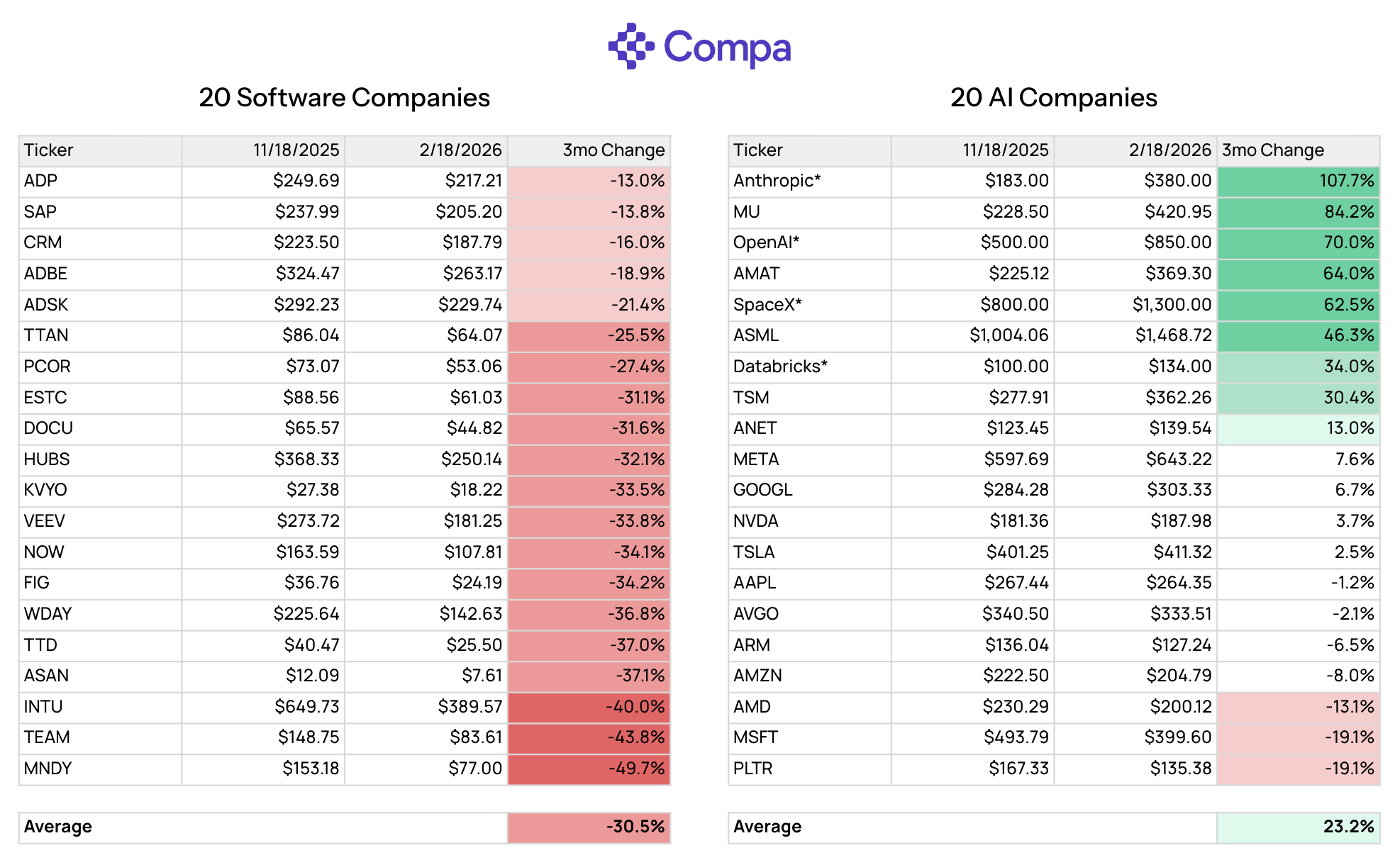
The software stocks are down -30.5% on average, ranging from -13% to -49.7%. This is the meltdown we’re all reading about.
Over the same period, the AI stocks are up +23.2% on average, ranging from -19.1% to 107.7%.
Now you can debate the exact composition of these comparator groups, and you should — in your own analysis, refine it to the peer companies you compete against, and sharpen the math with market cap or employee size weighting.
But make no mistake, the market is moving fast and non-uniformly, exposing risk and opportunity for talent competition.
Impact to unvested equity value
Unvested equity holds help retain talent and defend against competitors picking off our employees. So when stock value declines, retention risk rises.
If everyone’s stock goes down, we all ride the market together as an industry.
But if my stock does down and yours goes way up, my risk is your opportunity. This is precisely what’s unfolding now between software and AI companies.
The relative change in unvested equity value is a massive +77% advantage to AI companies.
Let’s look at a P4 Software Engineer as an example. Using Compa we can get the market median unvested equity value at $181,630 in November 2025.
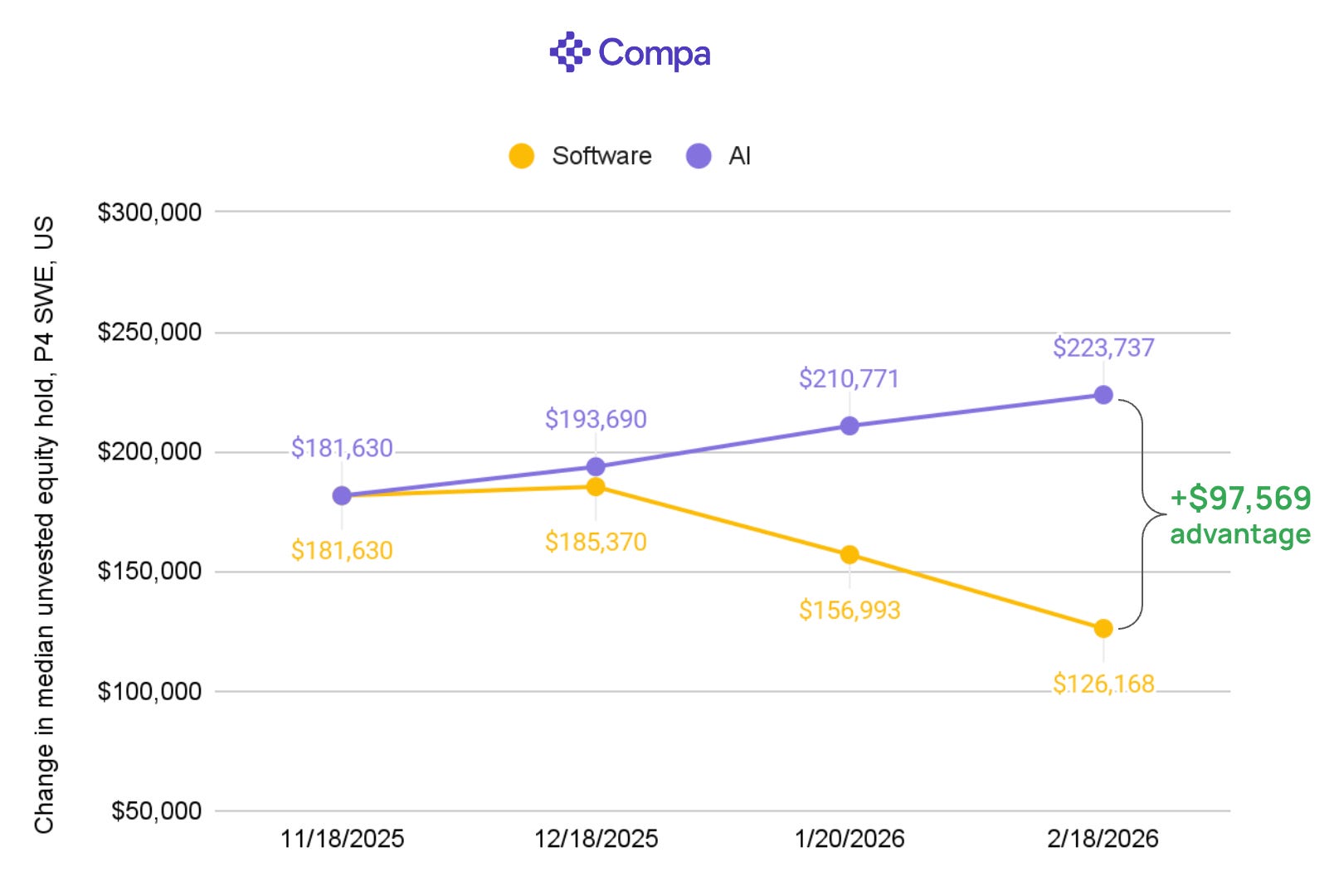
All else equal, this engineer’s unvested equity hold dropped on average to $126,128 at software companies and grew to $223,737 at the AI companies.
If the software company and AI company made the exact same target grant values, the AI company now has a $97,569 greater retention hold over the software company.
Harder to defend software, easier to compete in AI.
Going into the refresh grant cycle, comp teams who ignore the market change and age forward last year’s median survey grant value risk massively underpaying and hemorrhaging top talent, or massively overpaying and missing a market opportunity.
Here are some defensive and offensive strategies to compete for talent during the software meltdown.
Defensive and offensive strategies
What are the opportunities, imperatives, and constraints for defense (software) and offense (AI)?
Software defense
Brain drain mitigation: Your top performers are most mobile and at-risk — concentrate expanding unvested equity holds here by focusing on a ratio >1 of unvested equity to the median AI company new hire grant value + sign-on bonus
Voluntary attrition: You may quietly welcome voluntary attrition to manage costs and avoid layoffs — but protect key talent and teams that must weather the correction
Governance limits: Flexibility is constrained by stockholder-approved share pools and burn rate limits, but SBC expense goes down with lower prices — negotiate where you have the most flexibility, or turn to alternatives like cash and benefits (but beware of attracting a different talent profile)
Front-loading: Experiment with pulling equity grant value forward in the form of shorter vesting schedules and front-loaded grants, especially for current employee retention
Talent marketing: Market to new hires and refresh grant recipients that they are “buying low” and if the correction is overblown they could experience historic upside
AI offense
Talent discounts: Take advantage of the talent arbitrage; top performers at software companies are available at a steep discount — their target unvested equity hold could be trading closer to market median
Aggressive offers: Shift stock compensation budgets from current employees with high unvested holds towards new hire grants to maximize top talent attraction
Speed up growth: Pull forward annual hiring plans to Q1 to take advantage of market conditions, and ramp up marketing to generate talent market availability while software sentiment is down
Software targets: Temporarily construct a public software company peer group distinct from private AI competitors where you could concentrate hiring on top technical talent
Surgical tactics: Monitor software company layoffs and disclosure of exit package terms to selectively target top talent sources in your priority geographic markets
The cost of inaction
The Wall Street fears may be temporary or overcorrected — perhaps the software companies rebound and the AI stocks reprice, or perhaps not.
But either way, the next few weeks or months at a minimum represent a tactical opportunity for compensation teams to play smart defense and offense in the talent markets.
Inflexible teams relying on last year’s assumptions and stale data will make mispriced pay decisions.
Adaptive teams monitoring market conditions and real-time data will quickly and quietly accumulate advantage.
Peer Group is a newsletter for comp leaders navigating fast-moving markets and AI transformation! If you want to share my newsletter, you can forward this email to your colleagues and fellow comp leaders.
Want more polls and insights about the latest thinking in comp?
Subscribe by hitting the button below.